Living in Trabuco Canyon & Introduction to the Foothill/Trabuco Specific Plan
If you have ever driven along Live Oak Canyon Road in Trabuco Canyon, you’ve probably wondered how a place so rural – a place primordial; a true breath of Southern Californian beauty – could be so close to the edge of Orange County’s suburban sprawl… and – while you were pondering that, you probably also wondered if you could see yourself with horse stalls and chickens clucking nearby and wondered “Why not? Why couldn’t I live 30 minutes from the beach and live a rural life, too?”
The answer is – you can, but like so many things, it is complicated.
If you already live in or around Trabuco Canyon, you have likely heard references to the Foothill/Trabuco Specific Plan (the “FTSP”) and if you don’t live there, my guess is, the FTSP is probably new to you.
So what is the FTSP and why do we care? In brief, the FTSP plays a major role in shaping how land can be used and developed in this rural corner of Orange County.
At its core, the Foothill/Trabuco Specific Plan is a long-range land use plan adopted by the County to guide development in the foothills of the Santa Ana Mountains. Rather than applying standard suburban zoning rules, the plan establishes a tailored framework that reflects the area’s rugged terrain, environmental sensitivity, limited infrastructure, and long-standing rural character. As the plan itself explains, its intent is to provide “a comprehensive, integrated plan for the orderly development of the Foothill/Trabuco area in a manner that recognizes its environmental constraints and rural character.”
Before we dive into the FTSP, I just want to make a disclaimer – I am not a land use expert, I am a real estate agent who has sold enough land in Trabuco Canyon to understand why the FTSP is central to almost every land & home transaction in that area. Nothing here is meant to be used as legal advice for development. I’m probably going to leave out plenty of important topics unintentionally (there’s only so much space, after all), but I just thought I’d write a bit about the FTSP because I don’t see much out there that talks about it… and the more informed Buyers & Sellers are about the Plan, the better.
If you want to read a copy of the FTSP for yourself, you can download it here.
Why the Foothill/Trabuco Specific Plan Was Created

Atop a mesa near Trabuco Creek in Springtime in Trabuco Canyon
The Foothill/Trabuco Specific Plan was adopted in 1991, during a period when development pressure was increasing in eastern Orange County. County planners recognized that traditional zoning standards — designed for flatter, urbanized areas — were not well suited to the steep slopes, narrow canyon roads, oak woodlands, and natural drainage systems found in Trabuco Canyon and the surrounding foothills.
In short, the FTSP was created to balance private property rights with environmental protection and the conservation of the community’s character. Its stated goals include preserving open space, protecting scenic and biological resources, limiting excessive grading, and ensuring that new development is compatible with the area’s rural setting. The FTSP explicitly emphasizes that development should be “compatible with the natural terrain, environmental resources, and existing rural development pattern of the area.”
Where the FTSP Applies
The FTSP covers approximately 6,500 acres in the foothill and canyon areas centered around Trabuco Canyon, lands near O’Neill Regional Park, and areas adjacent to the Cleveland National Forest.
How the FTSP Shapes Development
One of the most important functions of the FTSP is that it replaces conventional zoning with plan-specific land use districts and development standards. These districts limit density, control building placement, and regulate grading far more strictly than typical suburban zoning.
The plan states that land uses and development intensity must be “consistent with the physical capabilities of the land, including slope, soils, and access,” reinforcing why large-scale suburban patterns are discouraged in the canyon.
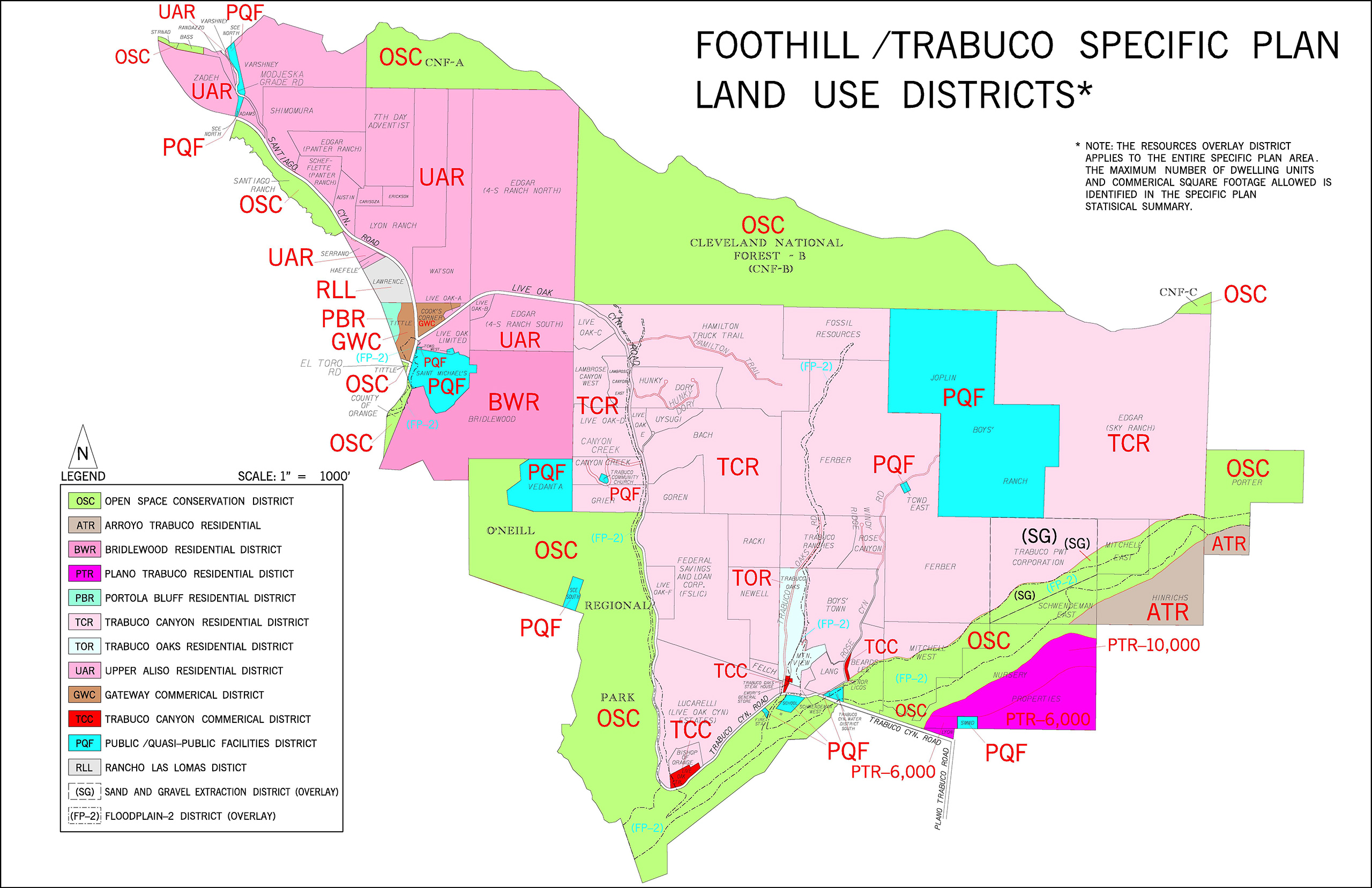
Foothill/Trabuco Specific Plan Land Use District Map
The FTSP Land Use District Map is the best guideline for finding your land use district and then diving into the limitations found for each District under the Land Use Regulations section of the FTSP (starts on page 72/225 in the FTSP)
In practical terms, where residential development is allowed, the FTSP’s Land Use Districts:
• Restrict residential density to maintain a low-intensity, rural pattern of development
• Limit grading on steep slopes to reduce erosion and visual impacts
• Require preservation of oak trees, natural drainage courses, and open space
• Establish design guidelines so homes and structures blend with the natural landscape rather than dominate it
Projects within the plan area are reviewed for consistency with these standards and may be subject to discretionary approvals, often involving review by the Foothill/Trabuco Specific Plan Review Board before final County decisions are made.
The FTSP and Equestrian Uses

A curious horse in a field of winter grass in Rose Canyon, Trabuco Canyon, CA
If you’ve driven through Trabuco Canyon proper or spent an afternoon at O’Neil Park, you’ve probably seen horse and rider saunter by, which is sadly an increasingly rarer sight in Orange County nowadays.
The good news is – a defining characteristic of Trabuco Canyon is its equestrian heritage, and the FTSP recognizes and supports equestrian land use as the FTSP’s 5th & last goal – “Equestrian/Recreational Opportunities: To provide equestrian and other recreational opportunities.” (see the Specific Plan Goals on page 13/225)
The plan also emphasizes the importance of maintaining open space and trail connectivity, which helps preserve the informal network of riding routes that residents value.
In practice, this means:
• Properties may be designed to accommodate horse keeping and riding, subject to plan standards
• Development is encouraged to avoid fragmenting open space and trail corridors
• Equestrian uses are treated as consistent with the area’s rural character rather than as nonconforming activities
This policy support helps explain why equestrian uses remain a visible and cherished part of life in Trabuco Canyon today.
What the FTSP Means for Buyers & Sellers
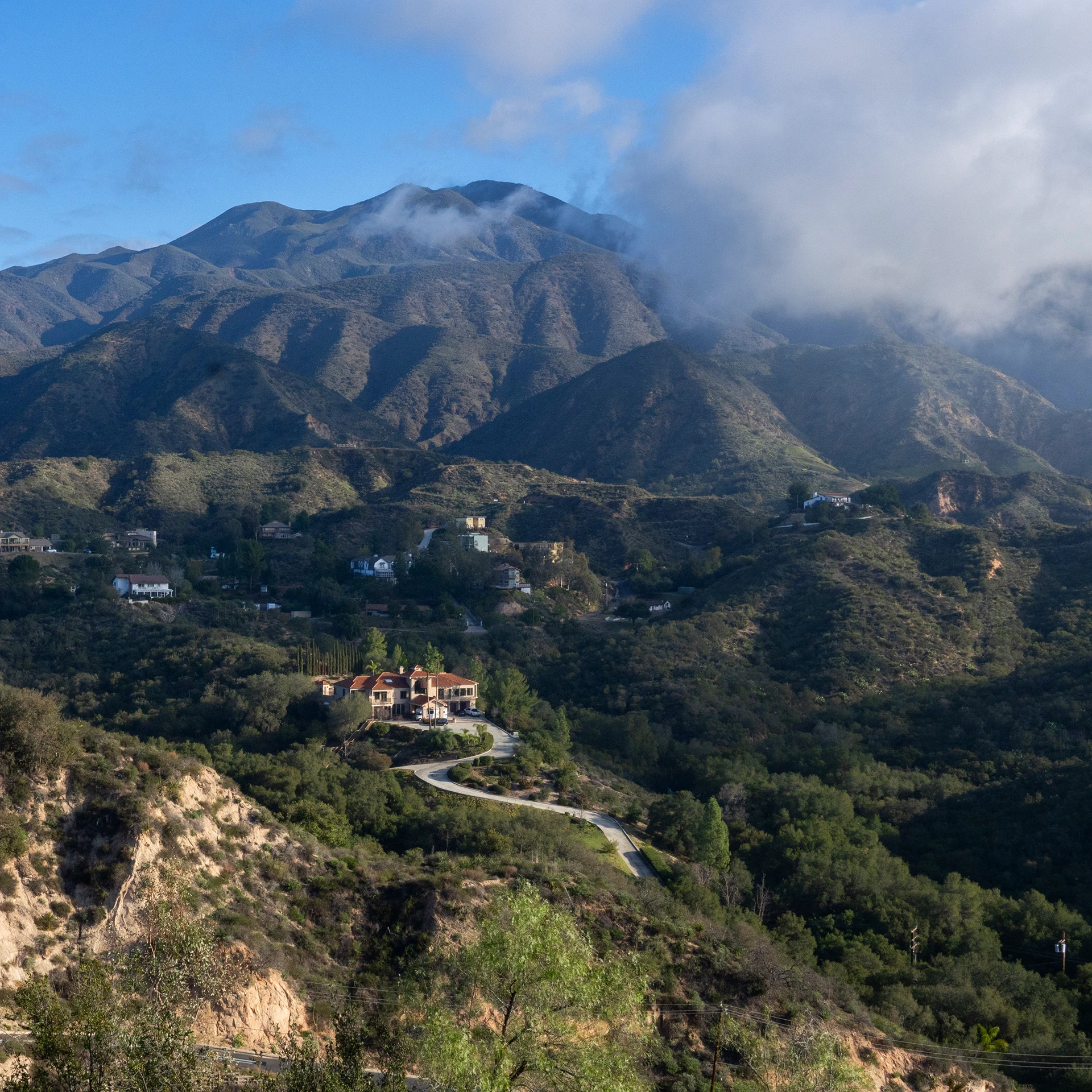
A few homes draped over canyon ridges in Trabuco Canyon
If you are considering buying or selling a home or land in Trabuco Canyon, here are a few things to consider:
For Buyers
• Expect lower density and a rural setting. The FTSP limits how much development can occur, which helps preserve open space, views, and privacy — but also means fewer large subdivisions and limited housing supply.
• That land you’re looking at is probably not a “blank slate just waiting to be developed.” Undeveloped parcels are subject to strict rules on grading, slope disturbance, tree preservation, access, and utilities. What looks buildable at first glance may require extensive review or modification.
• Future neighbors are constrained. The FTSP provides predictability: nearby properties are unlikely to be redeveloped into high-density or urban-style projects.
• Due diligence matters. Buyers should review the applicable FTSP land-use district, allowable density, and development standards before assuming expansion, ADUs, or new construction are feasible.
For Sellers
• Scarcity can support value. The FTSP’s limits on density and subdivision can make existing homes — especially those with views, usable land, or established improvements — more desirable.
• Development potential must be stated carefully. Marketing land or homes with “room to build” should reflect FTSP constraints; overpromising can derail transactions, which can hurt your value over time.
• Entitlements add value. Approved grading plans, prior use permits, or documented consistency with the FTSP can significantly strengthen a listing.
• Educated buyers move faster. Sellers who can clearly explain how the FTSP protects the area’s rural character often connect better with buyers seeking that lifestyle. (That means you should work with an agent who has at least some working knowledge of the FTSP)
Why the FTSP Still Matters Today
More than three decades after its adoption, the FTSP continues to play a major role in land use decisions in Trabuco Canyon. It explains why development in the area looks different from much of Orange County — fewer large subdivisions, more open space, and a built environment shaped by topography rather than grids.
For homeowners and buyers, the FTSP provides predictability about what can (and cannot) be built nearby. For the community as a whole, it represents an ongoing commitment to preserving the canyon’s unique character while allowing thoughtful, limited growth.
Understanding the FTSP helps explain not just how Trabuco Canyon developed, but why it still feels like Trabuco Canyon of years past.
I hope you enjoyed all of that!
If you are a buyer or seller looking at homes or land in Trabuco Canyon consider calling Jesse Brossa to help you navigate the process and do it right so you can be watching a sunset go down over canyon ridgelines instead of regretting a purchase you made without understanding what could (or couldn’t) be done there.